Understanding Gemini's Duality Through Myths and Tarot
Gemini season is in full swing! As a Gemini sun whose husband a Gemini moon and mother to 2 children with their moons in Gemini, there's a whole lotta Mercurial energy in this house all the time. As the "social butterfly" of the Zodiac, it's no wonder this time of year is one of our favorites. It's when the rest of you join us in a season of curiosity, chatter, and flights of fancy.
So in honor of it being the season of the twins, one that is near and dear to my family's hearts, let’s indulge in some mythological musings about the constellation Gemini, shall we?
The Greco-Roman star myths connect this constellation to Castor and Pollux, "twin" sons of Leda conceived by different fathers—Castor the son of a mortal, Pollux the son of Zeus. But, truth be told, while their twin-ness (although are they really twins if they have different fathers?) contains the concept of earthly and heavenly, a certain dichotomy incarnate within every human, as a strong Gemini personality, it doesn't feel unique to the Gemini traits.
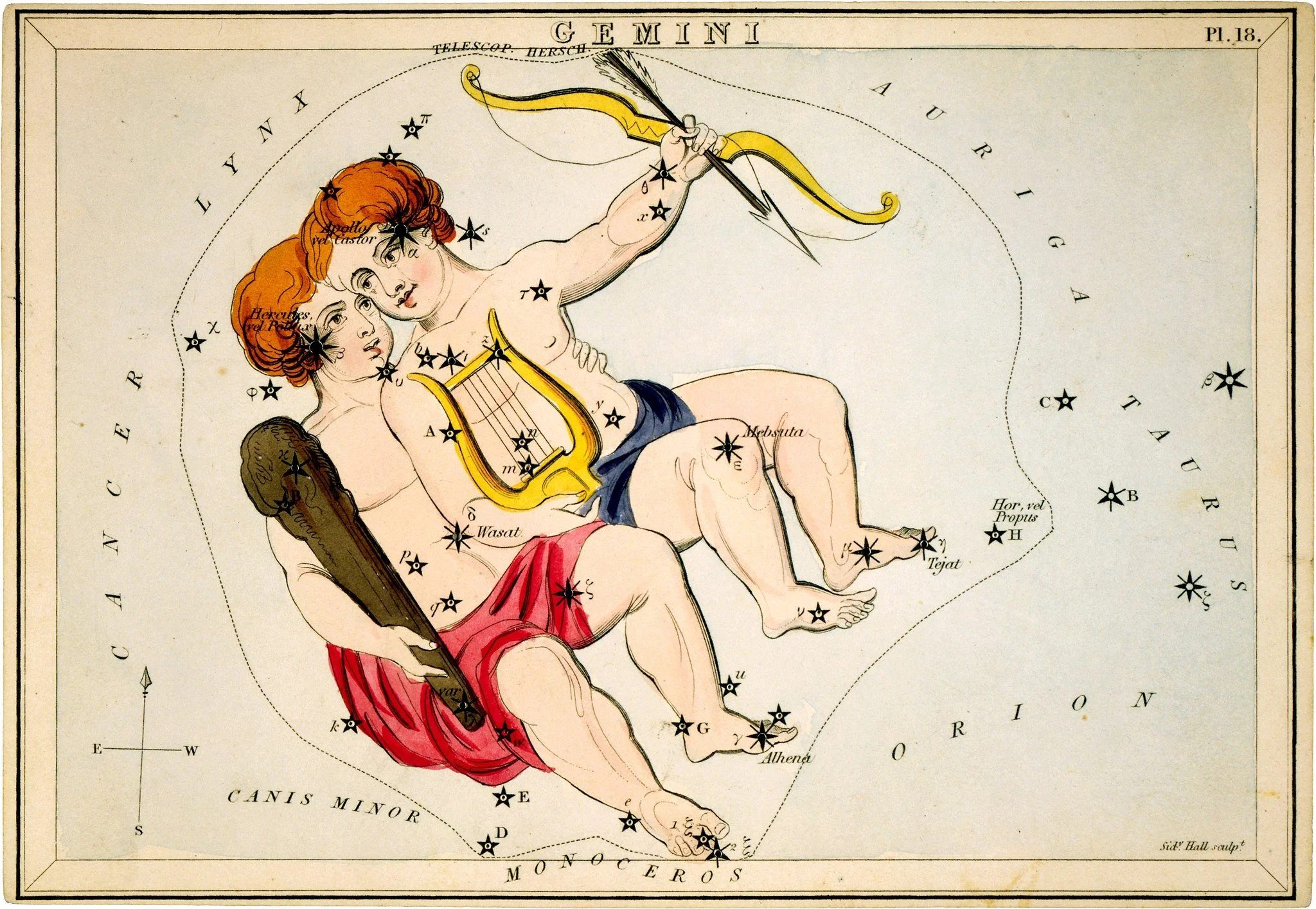
Sidney Hall, Public domain, via Wikimedia Commons
When I think of the twins who better embody the archetype of Gemini, as I've lived it, I think Apollo and Artemis.
Sure, Castor and Pollux give us the polarity of mortality (body) and immortality (soul)—but the nuanced energies of Apollo and Artemis feel like they demonstrate better the nature of a Gemini's contrasting personality. For instance:
Our first myth stars Apollo (solar god) and Gemini’s ruler.
The tale begins with Mercury, the mischievous trickster, who wakes one day feeling a little bored. So he thinks to himself, "Why not steal Apollo's cows for a bit of fun?” Being the crafty mastermind he is, he creates special shoes for the cattle, leading them away without leaving a trace. Predictably and justifiably so, an angry Apollo sets off to find his missing herd. But, when he finally locates Mercury, he is so intrigued by the messenger god's latest invention—the lyre, crafted from one of the very cows Mercury sacrificed to the gods—he instantly forgets his fury. Instead, Apollo offers Mercury a deal—he can keep the herd if only Mercury will surrender the lyre and teach Apollo to play it. Thus, the god of music is born.
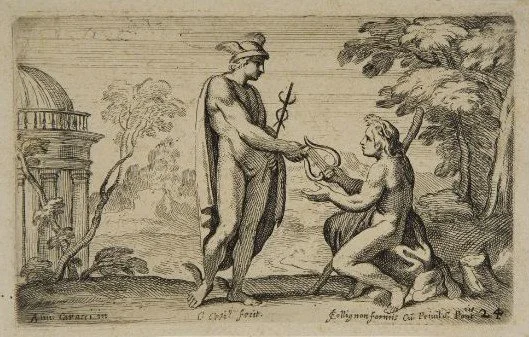
Mercury standing holding a lyre with Apollo seated before him; after Annibale Carracci. c.1640s Etching
Now, my favorite Artemis story, on the other hand, shows the darker nature of Gemini duality.
This myth begins with Actaeon—a hunter and Artemis devotee—blissfully unaware he's about to have a very bad day. While Actaeon is out hunting with his bros, Artemis (goddess of the hunt and of the moon), unbeknownst to them, is reveling in a waterfall bath with her nymphs, as maiden goddesses are wont to do. Actaeon hears a noise and follows it to its source, unwittingly catching a glimpse of Artemis in her divine nudity—a colossal no-no. Artemis, enraged when she catches site of him, transforms him into a stag. His dogs catch wind of his stag scent, pursue him and, well, do what hunting dogs are trained to do.
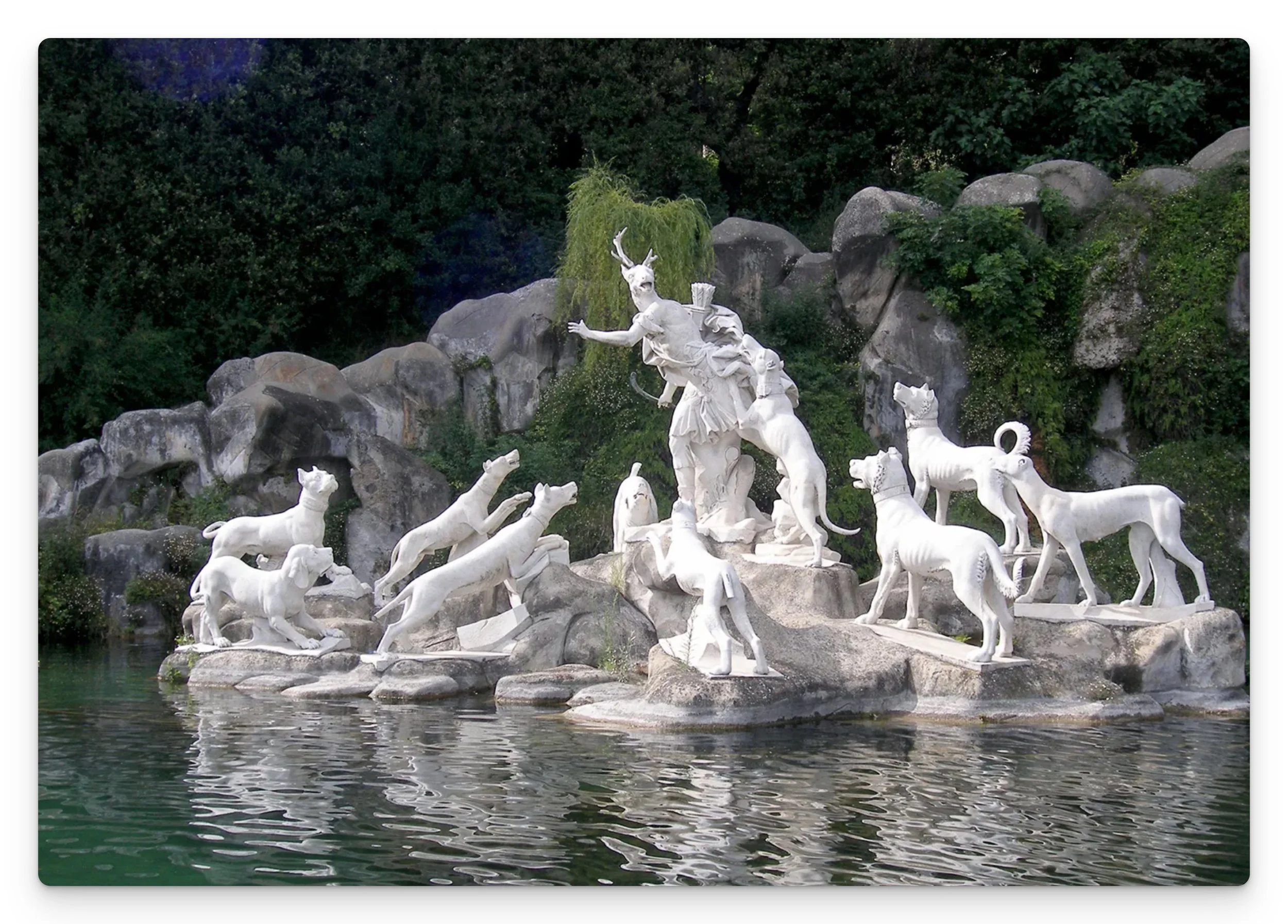
Actaeon being hunted by his own hounds, sculpture at the Royal Palace at Caserta, Italy.
japiot Creative Commons Attribution 2.5 (Generic)
Thus we see what happens when we carefree and convivial Gem's feel like you've crossed us.
So why are these my favorite of favs?
Firstly, Apollo’s lyre myth couldn't be more like the stereotypical Gemini—rage evaporates into curiosity at the sight of something shiny and new. Revenge plans are instantly shelved in favor of learning to do something more fun. As for the Artemis tale—it’s a slightly dramatic overreaction, sure, but show me a Gemini (sun, moon, or rising) who doesn’t get a little carried away now and then by a perceived slight.
And Artemis here shows just how fierce Gemini nature can be. We're always painted as these flighty, mercurial beings who never stop talking, when the truth is many of us have a acutely private side and those who violate pay dearly for it.
Gemini in the Tarot
The tarot card commonly associated with Gemini is The Lovers. However this feels somewhat superficial and arbitrary a selection, much like how the Castor & Pollux myth doesn't fit, this doesn't feel right to me either.
My choice as the card that best illustrates Gemini nature is the Two of Cups.
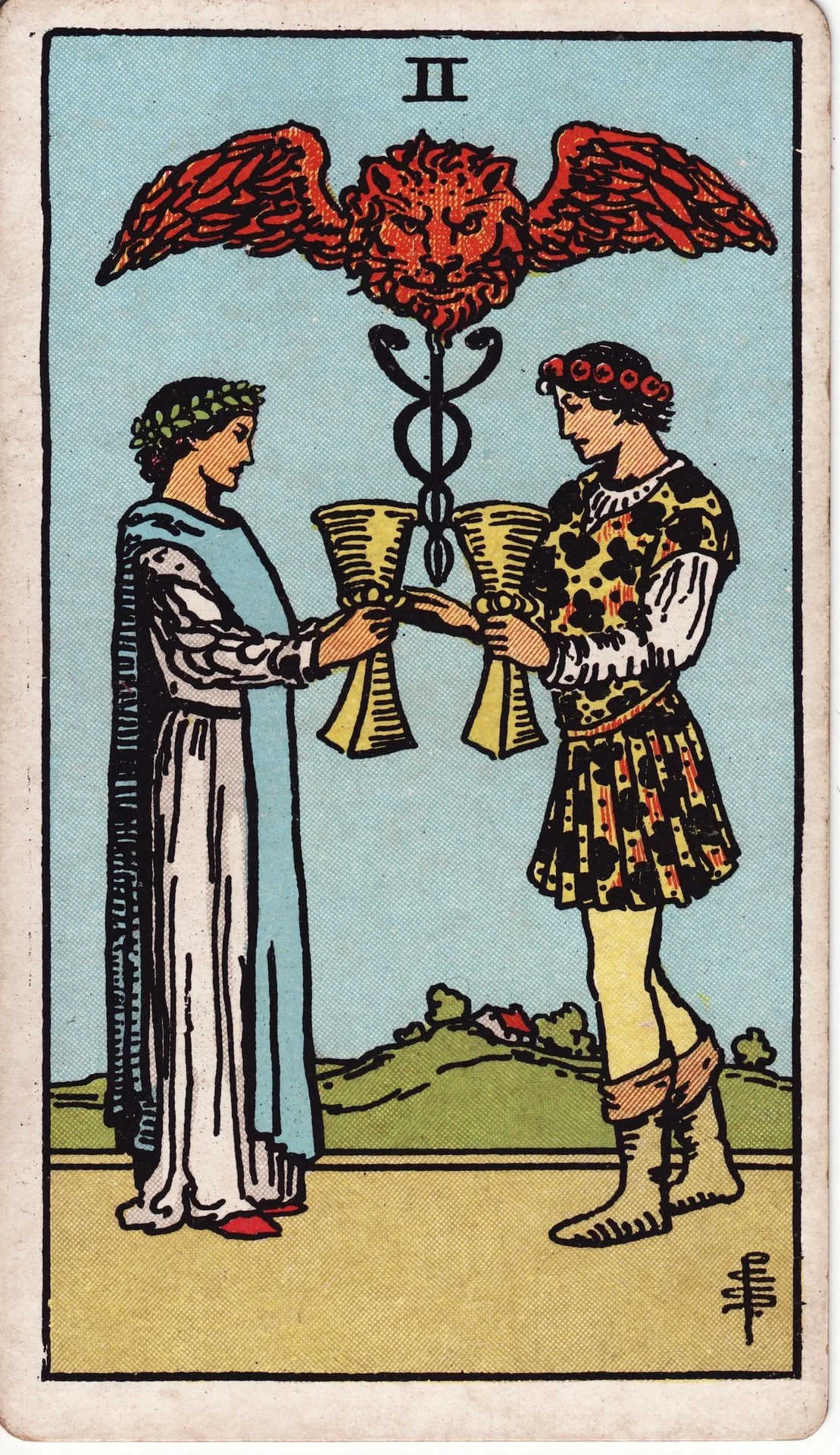
On the left we see a figure robed in white and blue, colors associated with lunar energy; while the figure on the right is clothed in yellows and red, which are colors related to the sun.
The caduceus above them is a symbol for alchemy, the bringing together two opposites to create one, and it's also the staff of Mercury (or Hermes in Greek mythology), who you may remember is Gemini's ruling planet. The lion's head above symbolizes many things, but in relation to Gemini it's alchemical meaning is the bringing together of fire and air. Which, while Gemini is an air sign, it is the mutable sign that ends on the summer solstice, the day the sun is in the sky for the longest time, and the sun is the ruler of the sign Leo, which is symbolized by the lion. Leo is a fire sign, and the amount of solar energy released onto the earth during this last day of the air sign could easily be signified with that same emblem.
Needless to say, Gemini energy and personalities aren't everyone's cup of tea.
Though we very much want to be since mostly we just want to sit down with someone new and ask them a million questions until we feel like old friends. It's true we're likely to forget their name or how we met by the next time we see them, but we thoroughly enjoy getting to know as many new friends as possible.
For those of you who are staunchly not Gemini, if there were one aspect of this season I might recommend harnessing, it'd be Apollo's uninhibited curiosity in asking to learn to play the lyre. You might just find you're meant for something you never even knew existed. And as for Artemis's energy, while I would never condone violence in any way, there's something to said about fiercely protecting what is sacred to you.
Until next time my friends…